How to Develop a Prop Firm Trading Strategy to Pass Funded Challenges
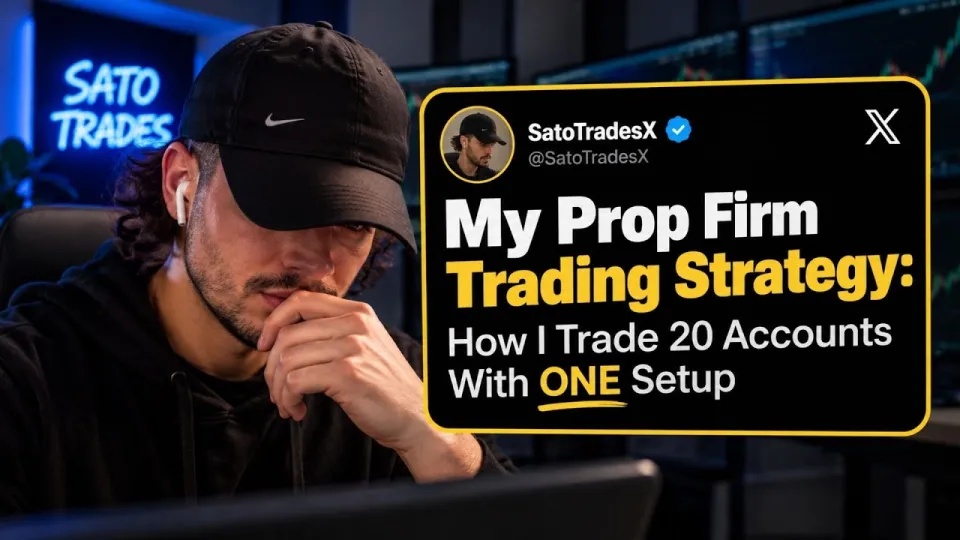
Video: Prop Firm Trading Strategy: How to Pass a Funded Challenge in 2026
A successful prop firm trading strategy is essential to passing funded challenges and achieving consistent payouts. This method relies on a clear, mechanical system that uses futures trading on 1-minute charts, focusing primarily on the S&P 500 E-mini (ES) and Nasdaq 100 (NQ) futures. It combines daily and intraday levels, careful risk management, and disciplined trade execution to help traders meet evaluation requirements and grow their accounts.
Understanding the Prop Firm Trading Strategy
The core of this strategy is to trade futures contracts with precise entries based on key price levels. These levels are identified daily before market open and include support and resistance points for ES and NQ futures. Traders mark these levels on TradingView, grouping and hiding them to keep the chart clean and focused. Entry signals occur when price action interacts with these levels, combined with confluence from higher timeframes.
Using a Mechanical Trading System on the 1-Minute Chart
This approach employs a mechanical trading system that defines exact entry, stop loss, and take profit points. The 1-minute chart allows for quick decision-making and precise timing. The system avoids discretionary or emotional trades by setting limit orders, stop losses, and profit targets in advance and then leaving them to execute automatically. This disciplined method reduces the risk of impulsive decisions and ensures adherence to the trading plan.
Risk Management Rules to Protect Your Funded Account
Proper risk management is the backbone of passing prop firm challenges. The strategy dictates risking a small, fixed percentage of the account per trade, often less than 1%. Stop losses are set tightly around the key levels to minimize losses if the market moves against the position. Take profits are placed to secure consistent gains while maintaining a favorable risk-to-reward ratio. This approach prevents large drawdowns that could lead to challenge failure.
Managing Market Structure and Price Action
A critical aspect is understanding when not to trade. The system incorporates market structure analysis to avoid entering trades during unclear or volatile conditions. For example, if the market lacks clear direction or breaks key levels without confirmation, traders wait for better setups. This discipline helps avoid unnecessary losses and ensures trading only when the probability of success is higher.
Scaling Prop Firm Trading Through Multiple Accounts
Once the initial funded challenge is passed, traders can scale their profits by managing multiple accounts simultaneously. Using trade copier software, it is possible to replicate trades across various prop firm accounts efficiently. This scaling method increases earning potential while maintaining the same proven strategy and risk parameters.
Tools and Resources for Prop Firm Trading
Traders are encouraged to use TradingView for marking daily and intraday levels and to join communities or mentorship programs for daily levels and bias updates. The use of trade copiers like Tradovate combined with software such as Tradecopia streamlines managing multiple funded accounts. Staying connected with other traders through Discord servers can also provide support and ongoing education.
Common Challenges and How to Avoid Them
Many traders fail prop firm challenges due to emotional trading, poor risk management, or unclear strategies. By sticking to a mechanical system, setting all orders in advance, and avoiding trades without confluence, traders can improve consistency. Additionally, focusing on futures like ES and NQ offers liquidity and volatility suitable for day trading.
Useful Links
- Daily ES & NQ levels, bias, and tutorials: https://satotrades.com/vip
- Best Futures Prop Firms Guide: https://satotrades.com/guides/best-futures-prop-firms
- Free Discord with daily levels discussion: https://discord.gg/Yt5PuQjXRp
- Trade copier software: https://portal.tradecopia.com/signup?via=SATO
Conclusion
Developing a prop firm trading strategy that passes funded challenges requires discipline, a mechanical approach, and strong risk management. Focusing on futures trading with daily key levels on the 1-minute chart, setting orders in advance, and avoiding emotional trading are critical to success. Scaling through multiple accounts can amplify profits once the strategy proves reliable. This comprehensive approach is detailed by the Sato Trades channel, a valuable resource for traders aiming to succeed in prop firm environments. For daily levels and mentorship, visit https://satotrades.com/vip to enhance your trading journey.
Key takeaways
- Use a mechanical trading system on 1-minute futures charts for precise entries
- Focus on ES and NQ daily levels for key support and resistance
- Apply strict risk management: set stop loss, take profit, and limit orders
- Avoid trading during unclear market structure or without confluence
- Scale trading through multiple accounts with trade copiers for growth
Source: Prop Firm Trading Strategy: How to Pass a Funded Challenge in 2026 · Markdown version
Questions & answers
What is the main time frame used in the prop firm trading strategy?
The strategy primarily uses the 1-minute chart for futures trading to identify precise entry and exit points.
How important is risk management in passing a prop firm challenge?
Risk management is crucial; it involves setting tight stop losses, limiting risk per trade, and adhering to predefined take profit targets to protect the funded account.
Can this strategy be applied to multiple prop firm accounts?
Yes, the strategy supports scaling by using trade copier software to replicate trades across several funded accounts efficiently.
What futures markets are recommended for this prop firm strategy?
The strategy focuses on the S&P 500 E-mini (ES) and Nasdaq 100 (NQ) futures due to their liquidity and volatility, which are suitable for day trading.