What Is Forex Trading and How Does It Actually Work in 2026?
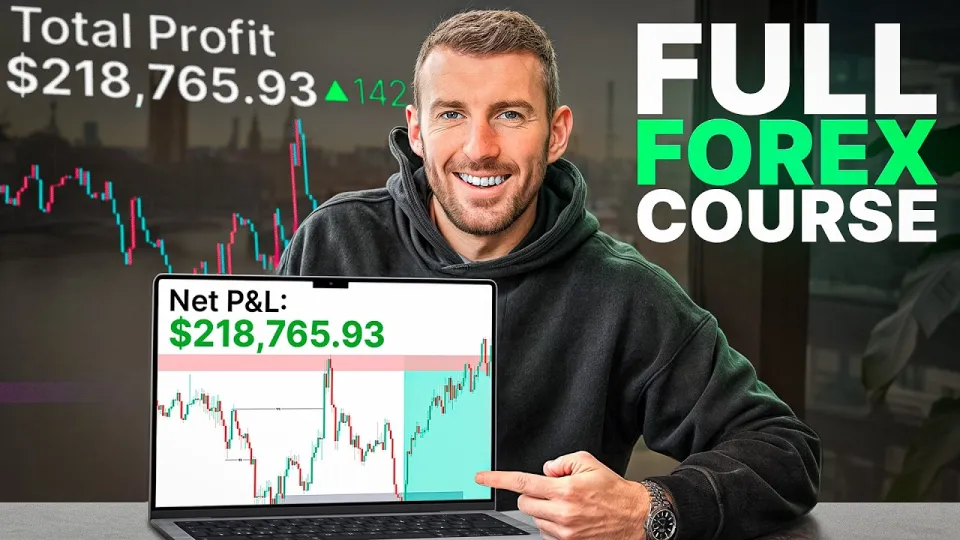
Video: Beginners Guide To Forex Trading In 2026 (+3 hours)
Need articles like this for your video? They help promote it on YouTube and Google — order them in the Telegram bot @sat_sit_bot. It writes articles around your video, embeds the video and publishes them on popular niche websites (no ads). Free trial — 50 articles.
Forex trading is the buying and selling of national currencies on the foreign exchange market, and it works as a decentralized network of banks, brokers, funds, and retail traders who exchange one currency for another at agreed prices. Retail traders speculate on currency pairs such as EUR/USD and GBP/USD through a broker, usually with leverage, aiming to profit from changes in the exchange rate. Matt Donlevey's 3-hour beginner guide for Photon Trading lays out the full path from market mechanics to a written trade plan, and the free course plus cheatsheets are available at the Photon Trading free training page.
What forex trading is and why the market moves
Forex trading is the exchange of one currency for another on the largest financial market in the world, with average daily turnover of roughly $7.5 trillion according to the Bank for International Settlements. Unlike stocks, there is no central exchange: currencies trade over the counter through a network of banks, electronic platforms, and brokers. The price of a pair like EUR/USD is simply how many dollars one euro costs at that moment, and it changes because buyers and sellers constantly renegotiate the auction.
That last point is the core of Donlevey's argument. Technical analysis alone gets a bad reputation because geometric shapes do not explain why price moves. To build a strategy on real market logic, a trader has to understand the underlying dynamics: who is trading, how orders are filled, and where liquidity sits. His guide spends its first hour on exactly that before touching a chart pattern.
How the plumbing works: bid, ask, spread, and order book
Every forex quote has two sides: the bid, at which the broker will buy from you, and the ask, at which it will sell to you. The difference is the spread, and it is your first trading cost on every position. A tighter spread means cheaper entry; a wider spread during news or at the daily rollover can quietly eat a short-term edge.
The order book is the deeper layer. It shows resting limit orders at various prices, and it explains why price often hesitates at certain levels and accelerates through others. Donlevey connects this to auction market theory and order flow: markets move to find areas where buyers and sellers are willing to transact, and imbalances between aggressive buyers and aggressive sellers create the short-term moves traders try to capture. Understanding this microstructure is what separates a strategy based on market logic from one based on shapes.
How you actually make money trading forex
Profit in forex comes from correctly anticipating the direction of a currency pair and managing the position so that gains outweigh losses over many trades. If you buy EUR/USD at 1.1000 and sell at 1.1050, you earn 50 pips per standard lot, which is $500 before costs. The reverse trade loses the same amount, which is why risk control matters more than any single forecast.
Donlevey's framework treats trading as a probability business, not a prediction business. A trader needs an edge, a repeatable setup, and a position-sizing rule that keeps any one loss small relative to the account. Leverage amplifies both outcomes: it lets a small deposit control a large position, but it also turns a modest adverse move into a large percentage loss. The guide's money-management section is built around that trade-off, and it is the part most beginners skip.
The Photon strategy: structure, supply and demand, liquidity
The Photon strategy is a systematic approach built on market structure, premium and discount zones, supply and demand, and liquidity concepts. Market structure is the sequence of swing highs and swing lows that tells you whether the market is trending up, trending down, or ranging. Donlevey breaks structure into three types and shows how to read them across multiple timeframes, so a trade on a five-minute chart aligns with the direction of the daily.
Premium and discount matter because traders want to buy relatively cheap and sell relatively expensive within a range. Supply and demand zones mark prices where large orders previously entered and may enter again. Liquidity concepts explain why price often sweeps obvious highs or lows before reversing: those levels hold resting stop orders that larger participants need to fill their positions. Entries, trade management, and exits are then assembled from these pieces rather than from indicators.
Common beginner questions and mistakes
Beginners usually ask three things: how much money they can make, how fast, and whether they need to trade someone else's capital. The honest answer is that returns depend entirely on edge, risk per trade, and consistency, and that prop-firm funding or managing other people's money is a later step that requires a verified track record, not a shortcut. Most new traders lose money because they size positions too large, move stops, or trade without a plan.
Donlevey highlights three recurring mistakes and pairs them with fixes: trading without a defined setup, risking too much on a single idea, and skipping review. His remedy is a written trade plan, a backtesting routine, and a journal that records the reason for every entry and exit. Choosing a broker and understanding trading costs, including spreads and commissions, belong in that same plan because costs compound against a high-frequency approach.
How to start: plan, backtest, journal, repeat
Starting in forex is a sequence, not a single decision. First, learn the mechanics: quotes, spreads, order types, and how margin works. Second, pick one setup from a structure-based framework and define entry, stop, and target rules precisely. Third, backtest that setup over a meaningful sample of historical trades and record the results. Fourth, trade it on a demo or small live account while journaling every decision. Fifth, review the journal weekly and adjust only when the data supports a change.
Trading psychology sits at the end of this chain, not the beginning. Donlevey's view is that you master the strategy first and build an edge; once the edge exists, the psychological work of executing it consistently becomes the main challenge. That ordering is why his guide spends hours on structure and liquidity before it discusses discipline.
Useful links
- Free Photon Trading course and cheatsheets
- Photon Trading mentorship
- Free Telegram channel with analysis and trade recaps
- Photon Trading on Instagram
Final thoughts
Forex trading rewards traders who understand the machinery behind price, not just the chart in front of them. The Photon Trading beginner guide by Matt Donlevey is a rare free resource that connects bid-ask mechanics, order flow, market structure, and risk management into one coherent system. Start with the free course and cheatsheets at photontradingfx.com/free-training, then build and test a single setup before risking real capital. The channel Matt Donlevey - Photon Trading is the author of this breakdown and the place to follow for further analysis.
Key takeaways
- Forex is the global currency market with about $7.5 trillion in daily turnover, the largest financial market in the world.
- Retail traders access it through brokers, mostly on margin, so a small deposit controls a much larger position.
- Price moves because of order flow: bids and asks, spreads, liquidity, and the auction process, not because of chart patterns alone.
- Matt Donlevey's Photon Trading guide builds a systematic strategy on market structure, supply and demand, and liquidity concepts.
- The free course and cheatsheets are available at photontradingfx.com/free-training.
Source: Beginners Guide To Forex Trading In 2026 (+3 hours) · Markdown version
Questions & answers
How much money can a beginner make trading forex?
There is no fixed number, because returns depend on your edge, risk per trade, and consistency. A realistic approach targets a small percentage gain per month with tightly controlled losses, not a doubling of the account. Anyone quoting guaranteed returns is selling something other than trading skill.
Do I need a large account to start trading forex?
No, because leverage lets a small deposit control a larger position, but that cuts both ways. Many brokers open accounts with a few hundred dollars, and the smarter path is to prove the strategy on a demo or micro account first. Risking a fixed small percentage per trade matters more than the account size.
Is technical analysis useless in forex?
Technical analysis is not useless, but shapes alone do not explain price movement. Donlevey's point is that patterns should be read through market structure, supply and demand, and liquidity, which reflect actual order flow. A strategy built on those dynamics has firmer logic than one built on geometry.
How long does it take to learn forex trading properly?
Expect months of study and practice before consistent execution, not weeks. The learning path includes market mechanics, one well-defined setup, backtesting, journaling, and a review cycle. Skipping the backtest and journal stages is the most common reason beginners restart from zero.